3QFP: Efficient neural implicit surface reconstruction using Tri-Quadtrees and Fourier feature Positional encoding
INFORMATION
Authors: Shuo Sun, Malcolm Mielle, Achim J. Lilienthal, Martin Magnusson
Published in: 2024 IEEE International Conference on Robotics and Automation (ICRA)
Neural implicit surface representations are a means to achieve high-fidelity surface reconstruction at a low memory cost, compared to traditional explicit representations. However, state-of-the-art methods still struggle with excessive memory usage and non-smooth surfaces — particularly problematic in large-scale applications with sparse inputs, as is common in robotics use cases.
Method
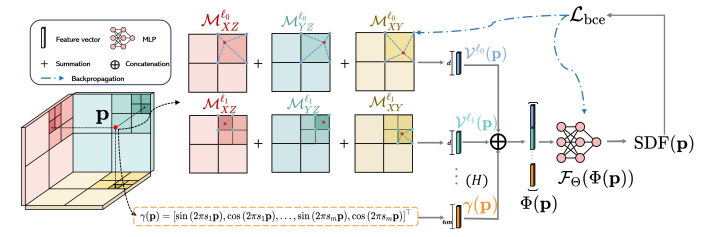
- We introduce a sparse structure, tri-quadtrees, which represents the environment using learnable features stored in three planar quadtree projections.
- We concatenate the learnable features with a Fourier feature positional encoding.
- The combined features are decoded into signed distance values through a small multi-layer perceptron.
Results
This approach facilitates smoother reconstruction with a higher completion ratio with fewer holes.
Compared to two recent baselines, one implicit and one explicit, our approach requires only 10%–50% as much memory, while achieving competitive quality.
What’s next
- Sparse implicit structures trade memory for implementation complexity; scaling them to whole buildings rather than rooms is the next step — the direction we took in buildnet3d.
- Thermal data is nearly textureless and hard for implicit surfaces — see thermonerf for how we handle it with neural radiance fields instead.