Exploiting semantic scene reconstruction for estimating building envelope characteristics
INFORMATION
Authors: Chenghao Xu, Malcolm Mielle, Antoine Laborde, Ali Waseem, Florent Forest, Olga Fink
Published in: Building and Environment
Other project website
Method
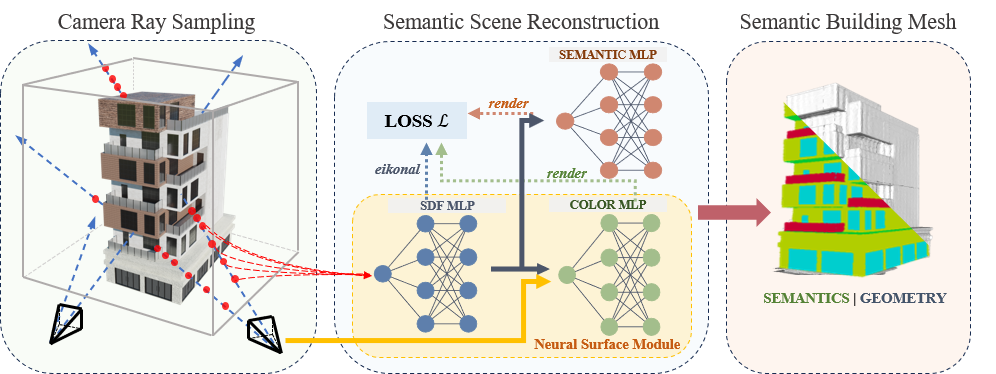
Precise assessment of geometric building envelope characteristics is essential for parametric simulation analysis and informed retrofitting decisions. Previous methods for estimating building characteristics, such as window-to-wall ratio and building footprint area, primarily focus on planar properties from single images, limiting the accuracy and comprehensiveness required for complete 3D building envelope analysis.
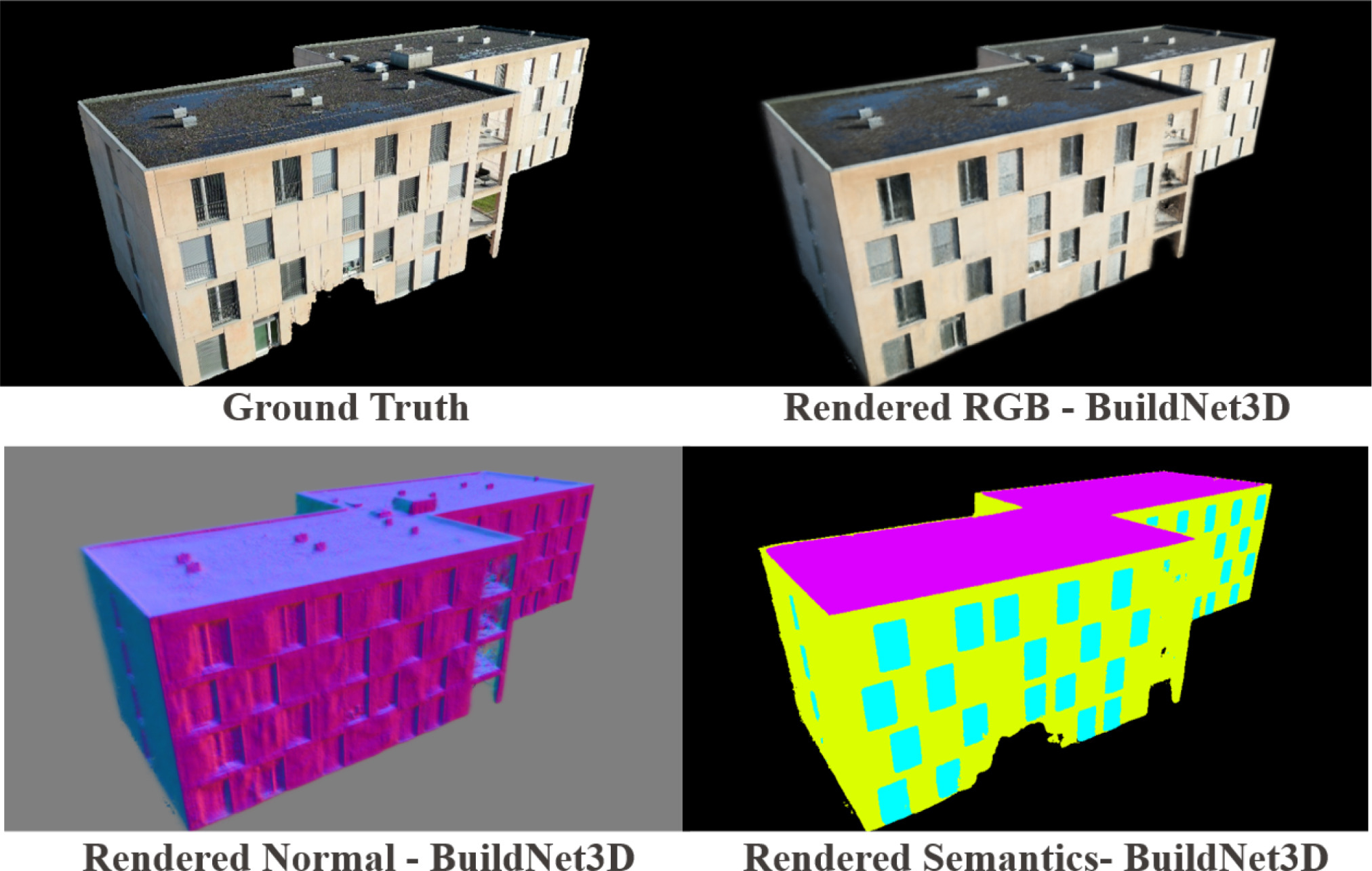
To address this limitation, we introduce BuildNet3D, a novel framework that leverages advanced neural surface reconstruction techniques based on signed distance function (SDF) representations for estimating geometric building characteristics. BuildNet3D integrates SDF representations with semantic modalities to recover fine-grained 3D geometry and semantics of building envelopes directly from 2D image inputs.
Evaluations on complex synthetic and real-world building structures demonstrate its superior geometry reconstruction performance and higher accuracy in estimating window-to-wall ratios and building footprints compared to 2D methods. These results underscore the effectiveness of incorporating 3D representations to advance building envelope modeling, characteristic prediction, and practical applications in building analysis and retrofitting.
What’s next
- Thermal: BuildNet3D recovers geometry and semantics — combining it with thermal reconstruction (ThermoNeRF, SEAR) to estimate envelope thermal performance is the goal of INSULATED.
- The BuildNet3D dataset enables benchmarking envelope estimation; extensions to more building types and regions would make it more broadly useful.
- Feeding estimated characteristics into energy simulation — the bridge we built in Thermoxels, and now also with spline-based reconstructions in FORGE-SIM (which uses the BuildNet3D dataset as one of its benchmarks).