A voxel-based method to generate simulation-ready 3D thermal models
INFORMATION
Presentation slides for CISBAT 2025
With Thermoxels, the question we asked is: “Is it possible to create a 3D reconstruction that is directly compatible with finite-element-analysis (FEA) software?” if you have worked with FEA, you know that creating the mesh for such a purpose is very difficult. They are constraints in:
- The elements you use in the representation and their interfaces.
- The size and position of those elements.
Thermoxels solves those problems by creating a voxel-based representation compatible with FEA, including both geometry and temperature, from a sparse set of RGB and thermal images.
Method
Thermoxels is a novel voxel-based method able to generate FEA-compatible models, including both geometry and temperature, from a sparse set of RGB and thermal images.
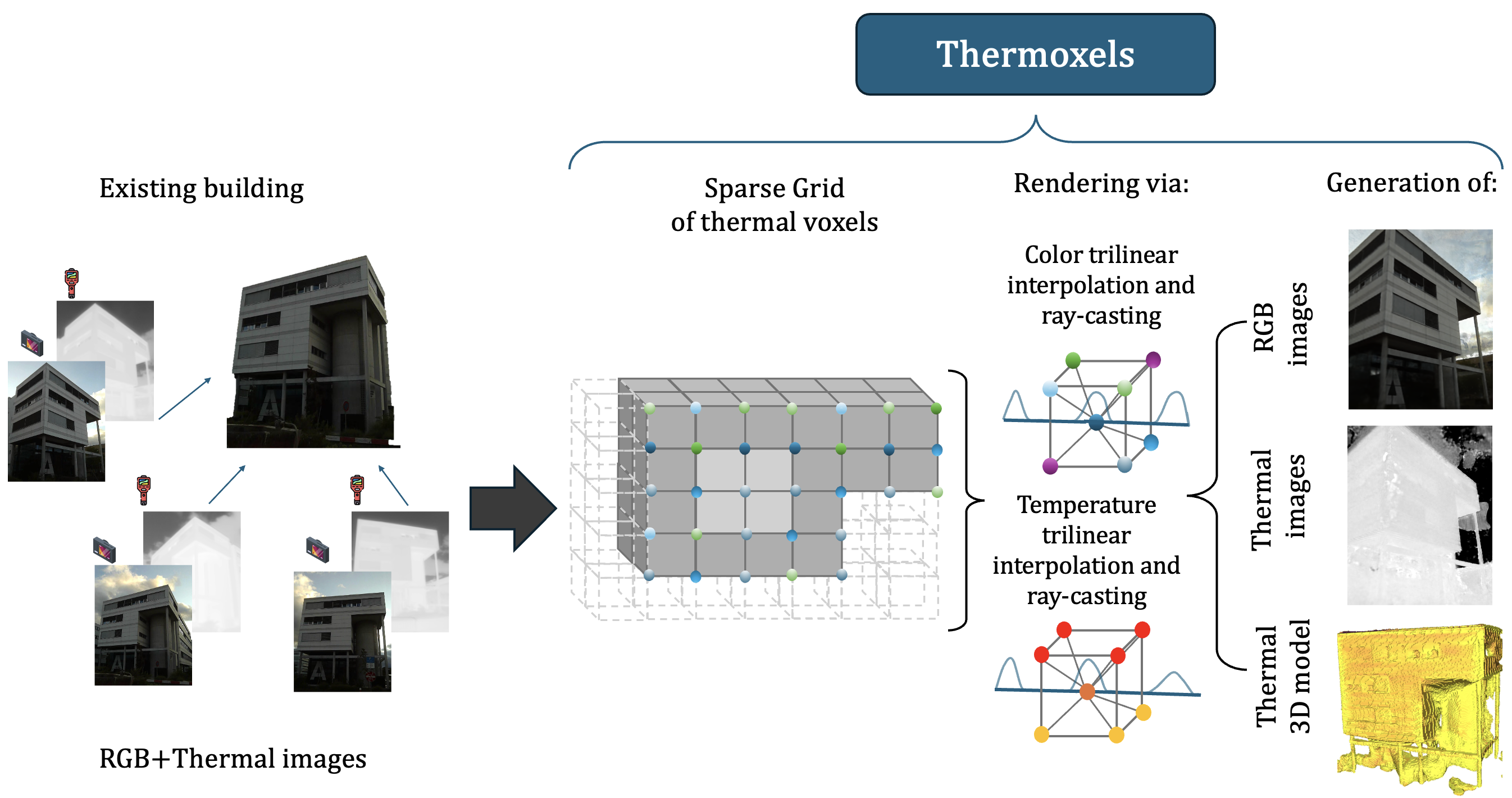 Using pairs of RGB and thermal images as input, Thermoxels represents a scene’s geometry as a set of voxels comprising color and temperature information.
After optimization, a simple process is used to transform Thermoxels’ models into tetrahedral meshes compatible with FEA.
Using pairs of RGB and thermal images as input, Thermoxels represents a scene’s geometry as a set of voxels comprising color and temperature information.
After optimization, a simple process is used to transform Thermoxels’ models into tetrahedral meshes compatible with FEA.
Results
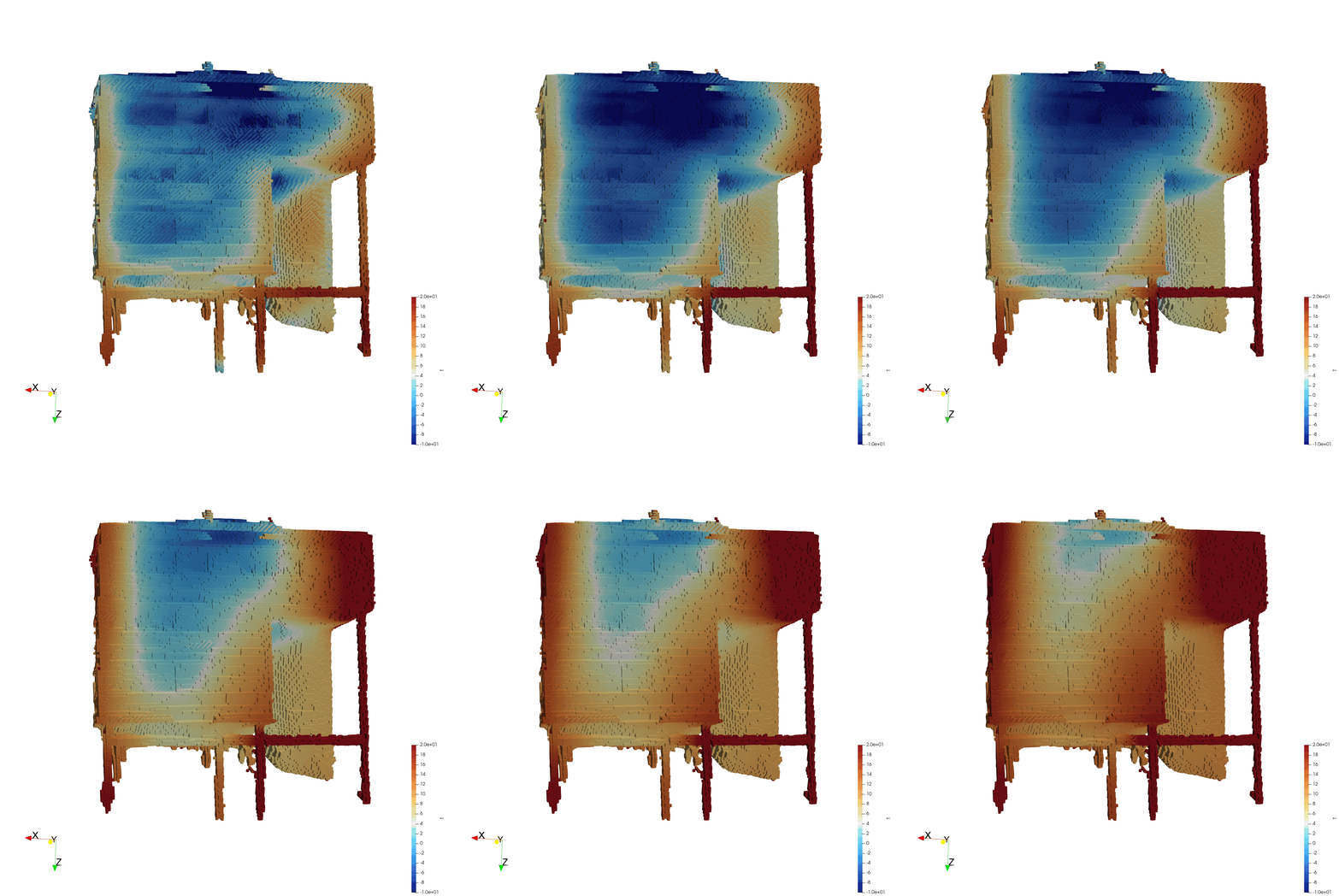
We conduct a simple heat conduction simulation using FEA, achieving convergence from an initial state defined by Thermoxels’ thermal reconstruction.
What’s next
- Coupling with retrofit decision tools: Thermoxels produces simulation-ready models — closing the loop from scan to retrofit recommendation is the goal of INSULATED.
- Mesh quality under sparse viewpoints: how few image pairs still yield a usable FEA mesh?
- FORGE-SIM follows up on the same goal with a spline-based representation instead of voxels — watertight and smooth by construction, with thermal fields inpainted in the same basis; see FORGE-SIM.
- Combining with learned thermal properties (PINN-it) to fill in material parameters the camera cannot see.