Research projects I lead or led as Principal Investigator — all taking multimodal sensing from the lab to application in the built environment.
INSULATED
Insulated: integrated solution for lean and abridged thermal evaluation with digital twins
Jan 2024 – Jan 2027 | Innosuisse | 317’814 CHF | Partners: Schindler, EPFL
Buildings account for a large share of energy consumption and CO₂ emissions, yet energy-saving investments are rarely prioritized — often due to a lack of trustworthy information about where retrofit actions will pay off.
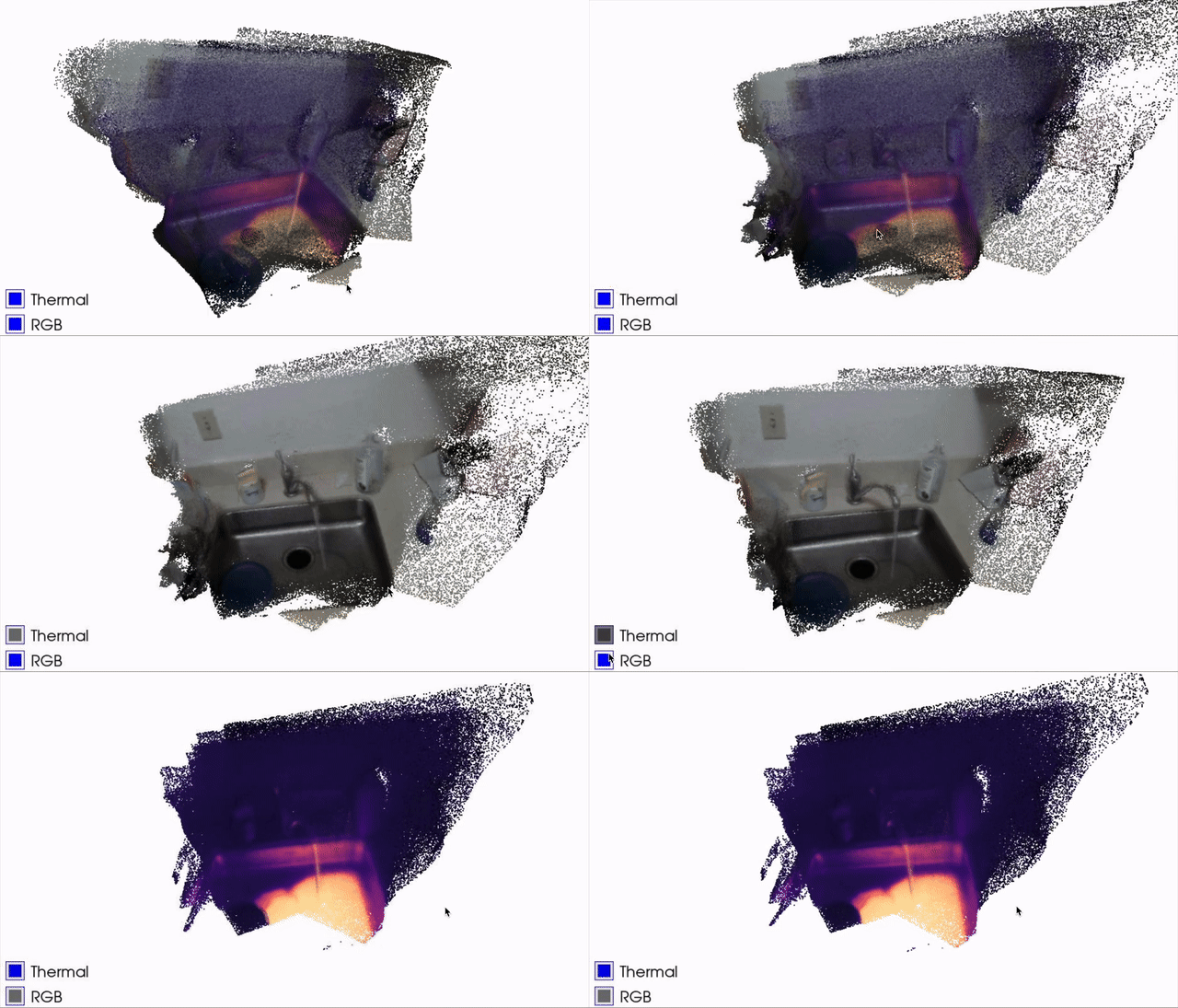
INSULATED builds the tools to change that: multi-sensor 3D reconstruction and thermal digital twins that make building envelope assessment lean, trustworthy, and actionable at scale.
What we built:
- ThermoNeRF — joint RGB-thermal novel view synthesis of building facades (Advanced Engineering Informatics, 2025), with the ThermoScenes dataset
- SEAR — adapting visual geometric transformers for RGB+Thermal 3D reconstruction, robust to low light and smoke (2026 pre-print), with a new RGB+T dataset
- FORGE-SIM — reconstructing B-spline boundary representations from sparse images, directly usable for thermal and modal simulation (2026 pre-print)
- BuildNet3D — semantic 3D reconstruction for estimating building envelope characteristics like window-to-wall ratio (Building and Environment, 2025)
- Thermoxels — voxel-based 3D thermal models directly compatible with finite-element simulation (CISBAT 2025)
- PINN-it — physics-informed neural networks for in-situ estimation of wall thermophysical properties
Team: co-directed with Prof Olga Fink (EPFL); PhD thesis of Chenghao Xu; Master students and interns at the Schindler EPFL Lab. See Supervision.
Safety Coach
Jan 2025 – Jan 2027 | Innosuisse | 269’334 CHF | Partners: Schindler, EPFL, HEIG-VD
Construction and maintenance work remains dangerous: workers need their hands free, attention split, and safety protocols hard to verify. Wearable sensors offer a way to detect activities and risky situations — but only if the AI behind them is reliable enough to act on.
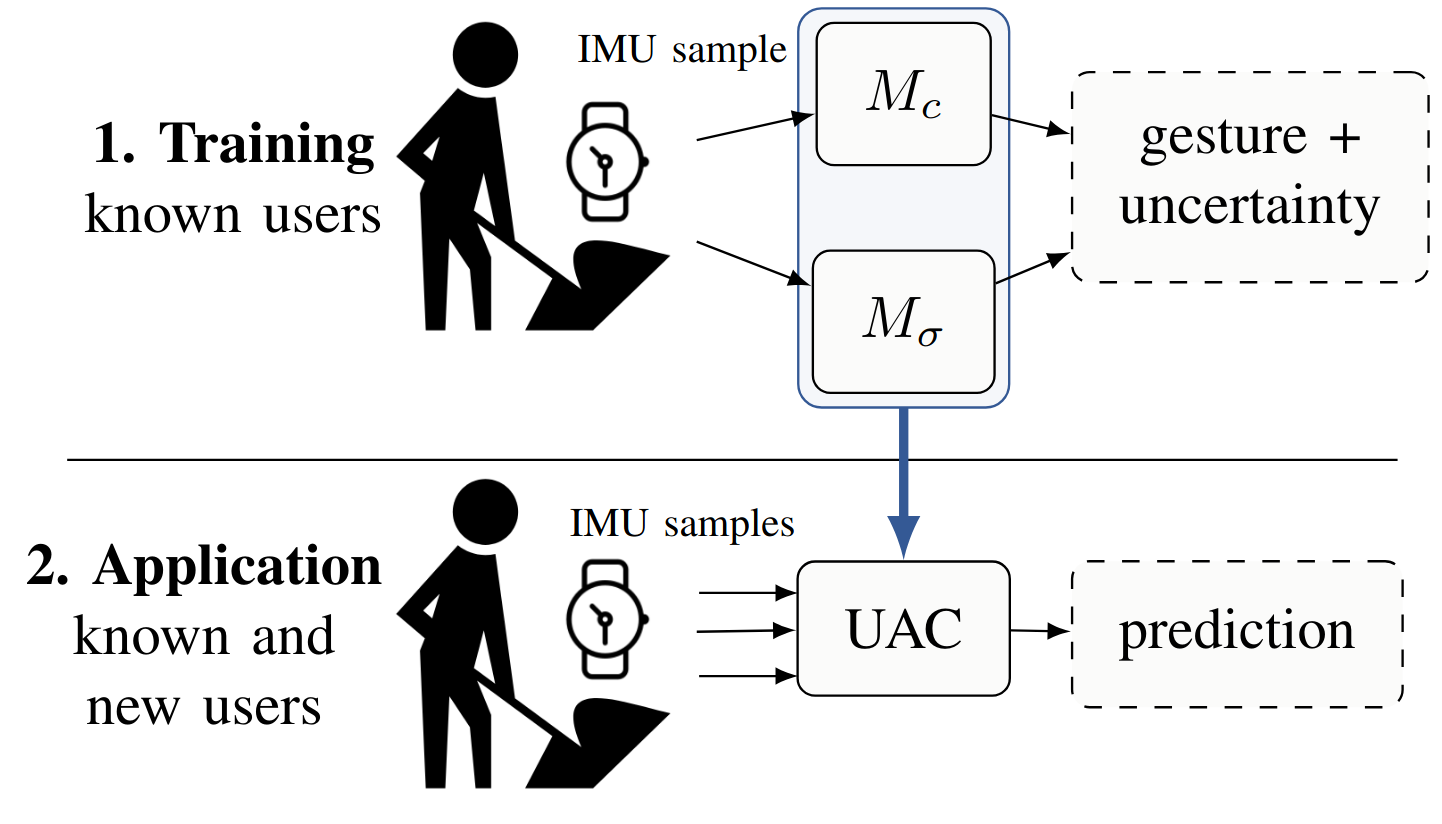
Safety Coach is an AI-based companion leveraging wearable and wireless sensors to improve safety on construction sites: activity detection via deep learning, calibrated uncertainty so the system knows when it doesn’t know, and focused alerts that reduce accidents instead of adding noise.
What we built so far:
- UAC — uncertainty-aware calibration of neural networks for gesture detection from IMU data: accurate probabilities even on out-of-distribution inputs
- D-CAT — decoupled cross-attention knowledge transfer: train with multiple sensor modalities, deploy with a single sensor (ICRA 2026)
Team: co-led with Dr Anisoara Ionescu (EPFL) and Prof Andres Perez-Uribe (HEIG-VD). See Supervision.
For the funding details behind these projects, see Grants. If you are interested in collaborating on either topic, see Collaborate.