New pre-print: FORGE-SIM — Spline-Based Boundary Representations for Sparse View Reconstruction and Simulation Using Isogeometric Analysis.
Reconstructions from images are visually impressive but not what simulation needs: numerical solvers require explicit, watertight, and smooth geometries — properties that surfaces extracted from image-based reconstructions lack. Converting a reconstruction into a simulation-ready model today means manual CAD re-modeling and mesh repair, a long-standing barrier between computer vision and numerical analysis.
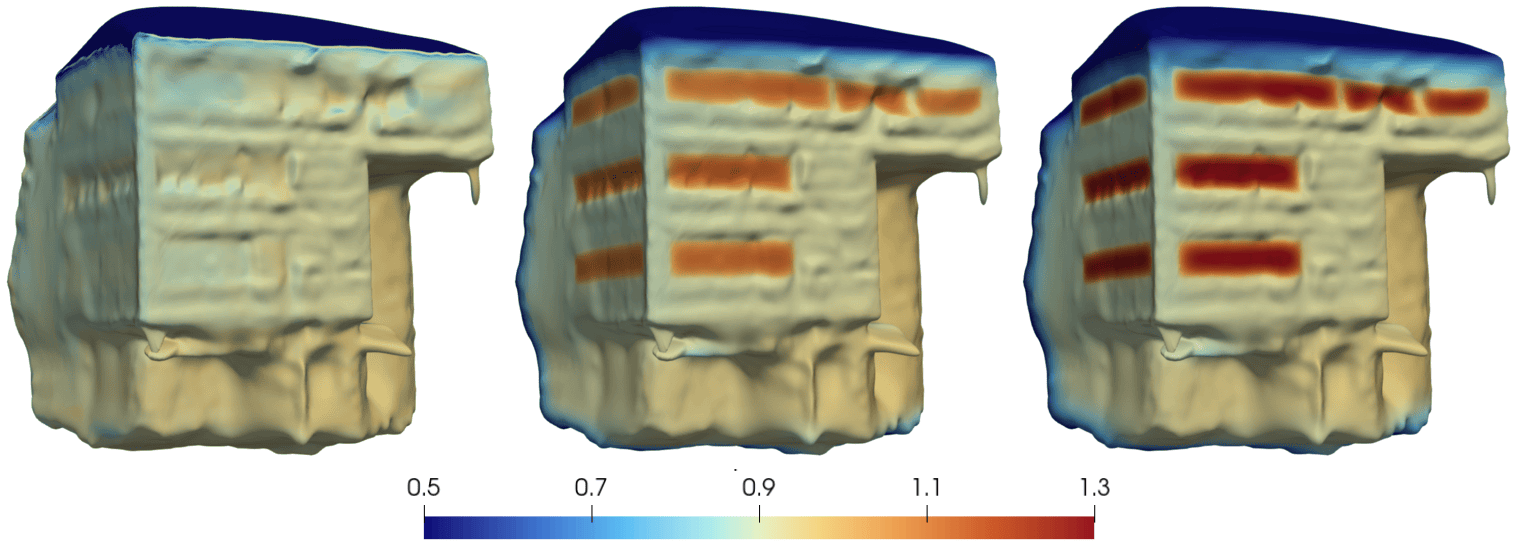
FORGE-SIM removes that barrier by optimizing the spline representation itself: it directly reconstructs a multi-patch B-spline boundary representation from sparse posed RGB images — compact, smooth, watertight, and natively compatible with CAD and simulation workflows, with no intermediate mesh export or format conversion. Thermal and semantic fields captured by thermography are inpainted in the same spline basis, enabling immediate use in simulation.
- Simulation runs directly on the reconstruction: IGA-based heat-flow and modal simulations on FORGE-SIM models agree with FEM on ground-truth meshes — errors from below 1% up to ~20% depending on reconstruction difficulty, tracking reconstruction error rather than diverging (field discrepancy as low as 1.07–1.41% on the best shapes)
- No fidelity trade-off: lower Chamfer distance than the leading mesh-based shape-optimization method (Large Steps) on 7 of 8 objects — by close to an order of magnitude on the hardest one
- Complete image-to-simulation pipeline demonstrated on real-world buildings, from infrared thermography to thermal simulation and modal analysis
This work is part of the INSULATED project on thermal digital twins for building retrofit — closing the loop from images to simulation-ready models, where Thermoxels took the voxel-based route.