UAC: Uncertainty-Aware Calibration of Neural Networks for Gesture Detection
INFORMATION
Artificial intelligence has the potential to impact safety and efficiency in safety-critical domains such as construction, manufacturing, and healthcare. Using sensor data from wearable devices such as inertial measurement units (IMUs), human gestures can be detected while maintaining privacy, thereby ensuring that safety protocols are followed.
However, strict safety requirements in these domains have limited the adoption of AI, since accurate calibration of predicted probabilities and robustness against out-of-distribution (OOD) data is necessary.
Method
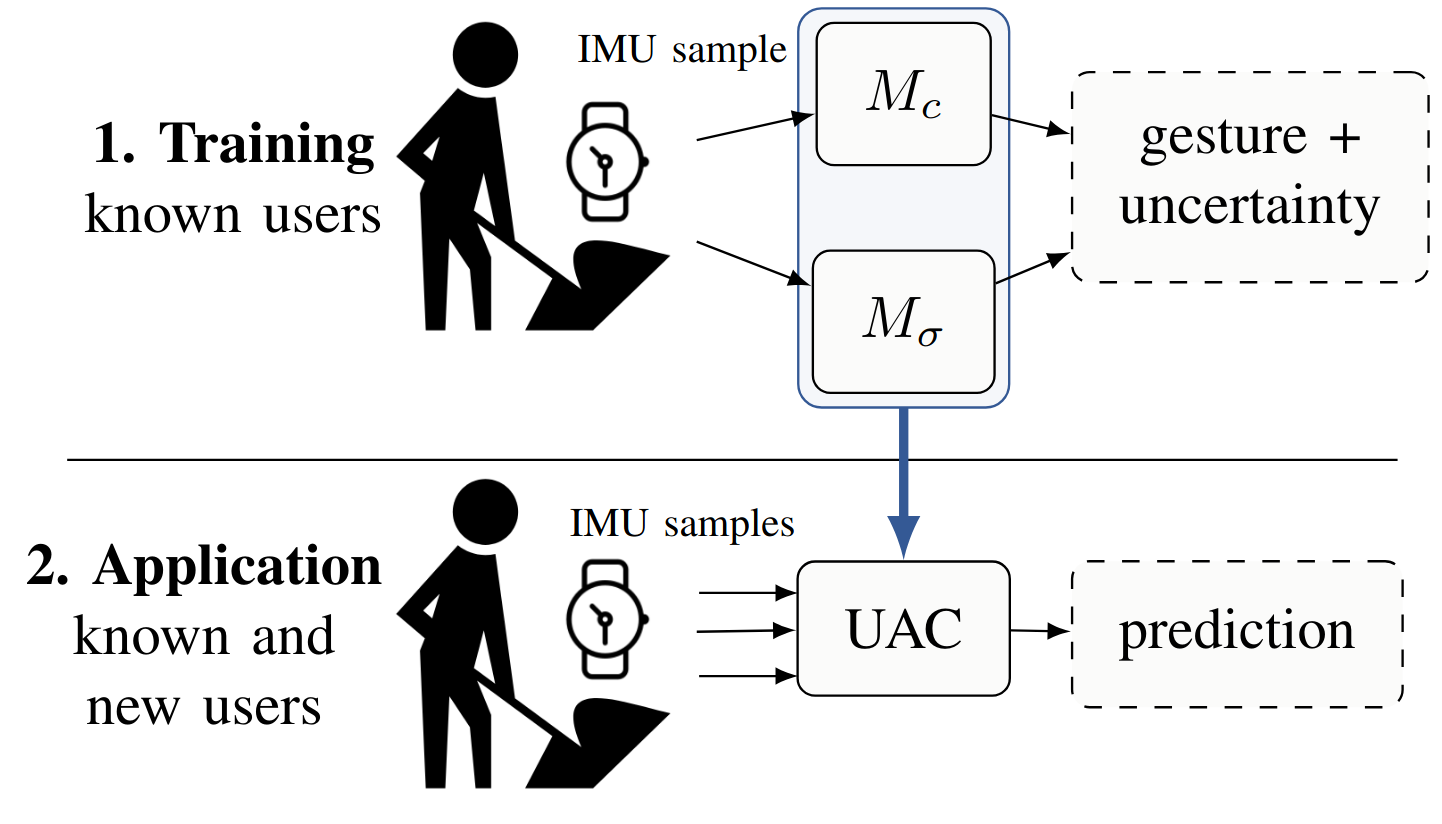
We propose UAC (Uncertainty-Aware Calibration), a two-step method to address these challenges in IMU-based gesture recognition:
- An uncertainty-aware gesture network architecture that predicts both gesture probabilities and their associated uncertainties from IMU data. This uncertainty is then used to calibrate the probabilities of each potential gesture.
- An entropy-weighted expectation of predictions over multiple IMU data windows, used to improve accuracy while maintaining correct calibration.
Results
Evaluated on three publicly available IMU datasets for gesture detection, and compared against temperature scaling, entropy maximization, and the Laplace approximation, UAC outperforms existing methods — achieving improved accuracy and calibration in both OOD and in-distribution scenarios.
This work is part of the Safety Coach project on AI-based safety for workers on construction sites.
What’s next
- Deploying calibrated gesture detection on actual construction sites: hardware constraints, sensor placement, and long-term drift.
- Extending uncertainty-aware calibration to other sensing modalities — see D-CAT for training with multimodal data while deploying with a single sensor.