TEAM: A Parameter-Free Algorithm to Teach Collaborative Robots Motions from User Demonstrations
INFORMATION
Authors: Lorenzo Panchetti, Jianhao Zheng, Mohamed Bouri, Malcolm Mielle
Published in: Proceedings of the 20th International Conference on Informatics in Control, Automation and Robotics (ICINCO)
Learning from demonstrations (LfD) enables humans to easily teach collaborative robots (cobots) new motions that can be generalized to new task configurations without retraining. However, state-of-the-art LfD methods require manually tuning intrinsic parameters and have rarely been used in industrial contexts without experts.
Method
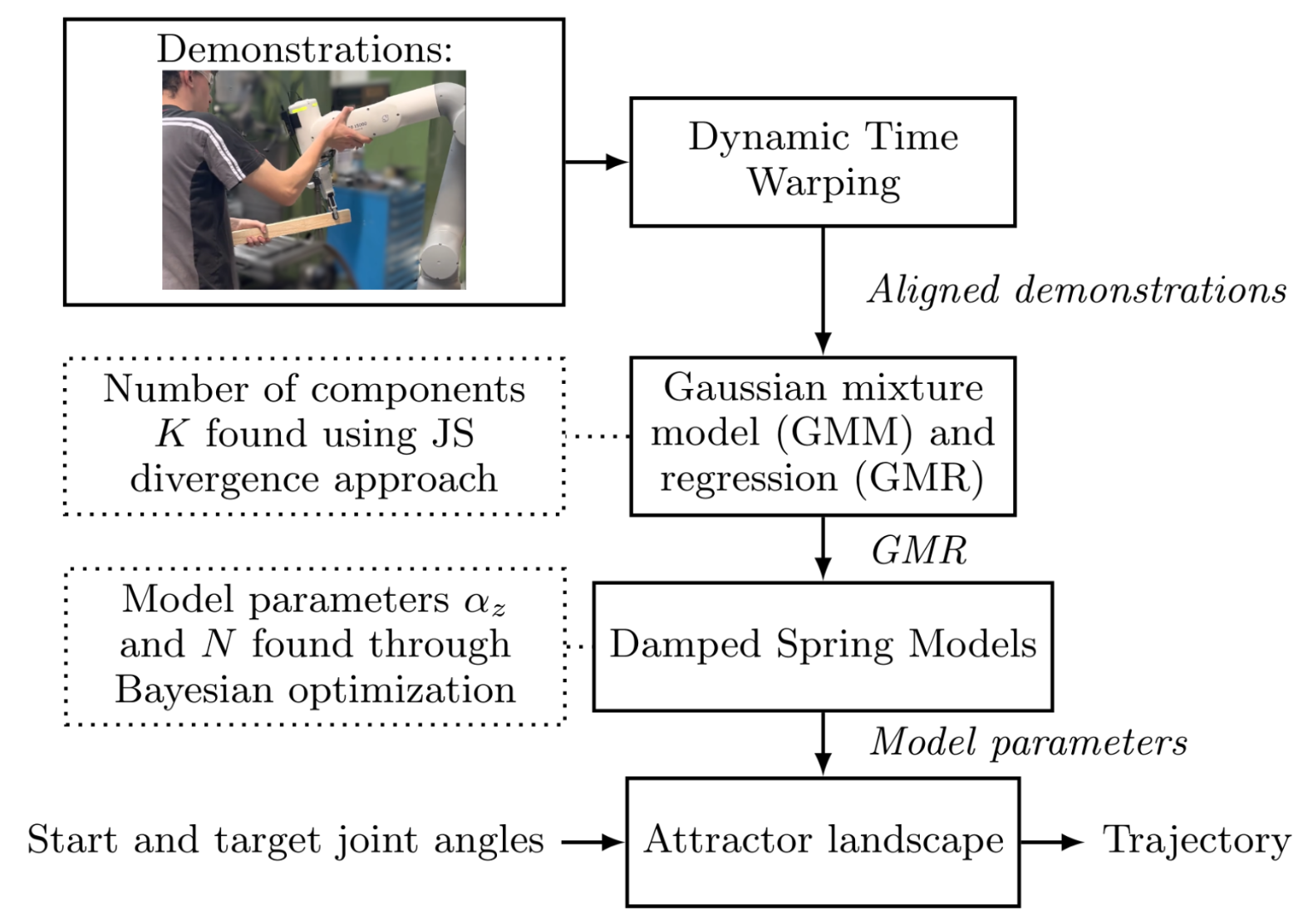
We propose a parameter-free LfD method based on probabilistic movement primitives, where parameters are determined using Jensen-Shannon divergence and Bayesian optimization, and users do not have to perform manual parameter tuning.
The cobot’s precision in reproducing learned motions, and its ease of teaching and use by non-expert users were evaluated in two field tests:
- In the first field test, the cobot works on elevator door maintenance.
- In the second test, three factory workers teach the cobot tasks useful for their daily workflow.
Results
Errors between the cobot and target joint angles are insignificant — at worst 0.28° — and the motion is accurately reproduced (GMCC score of 1).
Questionnaires completed by the workers highlighted the method’s ease of use and the accuracy of the reproduced motion.